
Key takeaways
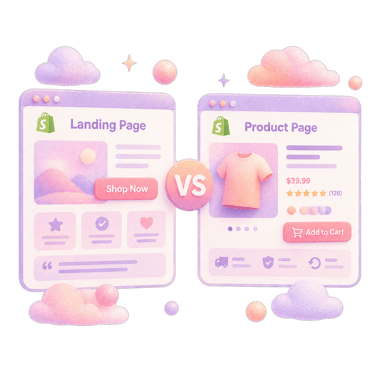
- A landing page is a purpose-built page for a campaign or audience; a product page is the catalogue entry for a single SKU. Different jobs.
- Send cold paid traffic to a landing page. Send branded search and warm direct traffic to the product page. The middle (organic, email) depends on context.
- Landing pages typically outperform product pages for cold traffic by 30-60% on conversion rate, because they remove distractions and pre-qualify the visit.
- Product pages usually beat landing pages for warm traffic and SEO-driven traffic because the catalogue context (variants, related products, reviews) supports the high-intent buyer.
The most common Shopify funnel mistake: sending cold paid-social traffic to a product page. The PDP exists for catalogue context; the cold visitor needs a purpose-built page. This piece breaks down which to use when.
Why you can trust us
Four years inside Shopify, hundreds of LP and PDP builds. We build Fudge, used by merchants to ship both LPs and PDPs as native theme code.
What each page is for
Product page (PDP)
The catalogue entry for a single SKU. Contains: the product, all variants, all reviews, related products, cross-sells, full description. Built to support the buyer who already knows broadly what they’re looking for and is comparing or evaluating.
The PDP is also the page Google indexes for product-related search queries. SEO traffic goes here.
Landing page (LP)
A purpose-built page for a specific audience or campaign. Contains: a focused promise, one CTA, the social proof that supports that promise, and the trust signals that close the sale. Built to convert the visitor without offering the full catalogue.
LPs are typically not indexed (campaign-specific) or are indexed for specific commercial intent queries.
For PDP fundamentals see anatomy of a high-converting Shopify product page. For LP examples see Shopify landing page examples.
When to use which
Use a landing page when
- You’re running paid ads on a cold audience. The LP filters and qualifies in a way the PDP can’t.
- You’re launching something new. Product launches benefit from the LP’s focused narrative.
- The pitch needs more storytelling than the PDP allows. Founder-led brands, sustainability brands, story-driven categories.
- You’re A/B testing a different value proposition. LPs are cleaner test surfaces than PDPs.
- You’re running a campaign-specific offer (BFCM, Mother’s Day, free shipping promo).
- The audience needs more pre-qualification than a PDP provides (quizzes, comparison pages).
Use a product page when
- The traffic is warm (returning, direct, email, branded search). The buyer wants catalogue context, not narrative.
- The product is well-known and the buyer is comparing variants or specs. Variant selectors and review depth matter more than story.
- You want the page to rank organically. PDPs are indexed; product schema is supported natively.
- The product is part of a category browse path. Customers entering through a collection page expect a PDP.
Trade-offs
Conversion rate
Cold paid traffic on a landing page typically converts 30-60% better than the same traffic on a PDP. The LP removes distractions (variant decisions, related products, reviews of other products) and qualifies the visitor in.
Warm traffic on a PDP typically converts better than the same traffic on a generic LP, because the PDP provides the catalogue context the warm buyer is asking for.
SEO
PDPs are indexable, schema-supported, and rank for product-related queries. LPs typically don’t rank unless built specifically for an SEO intent.
If your goal is organic acquisition, the PDP is the page. If your goal is to convert paid traffic at the lowest CPA, the LP is the page.
Maintenance
PDPs scale automatically with your catalogue. New product = new PDP. LPs are bespoke. Each LP is a maintenance commitment.
The implication: don’t build LPs you won’t maintain. A stale LP from a 2024 campaign that’s still running ads in 2026 is a brand liability.
Speed to ship
A new PDP is part of the product launch flow - usually fast. A new LP is a build commitment. Tools like Fudge compress LP build time substantially; without one, LPs are typically a multi-hour build per page.
The hybrid pattern
For high-intent commercial keywords (“best skincare for oily skin”), the optimal page is often a hybrid: structured like an LP with a clear promise and pre-qualification, but indexed and built with PDP-style schema and reviews.
Most strong Shopify stores have both PDPs and a small set of “evergreen LPs” for high-volume keywords. The evergreen LPs combine catalogue depth (multiple recommendations) with LP-style focus.
A decision framework
Three questions:
- What’s the traffic source? Cold paid → LP. Warm direct/email/branded → PDP. Organic search → PDP for known queries, LP for commercial-research queries.
- Does this campaign have a specific offer or audience? Yes → LP. No → PDP.
- Will this page rank in search? Yes → PDP-style with full content. No → LP-style with focused conversion.
When in doubt: start with the PDP, build an LP only when you can articulate why the PDP isn’t enough.
For wider CRO context see Shopify CRO guide. For LP build mechanics see best Shopify page builders.
FAQ
For cold paid traffic, yes - LPs typically convert 30-60% better. For retargeting paid traffic on warm audiences, the PDP often wins because the buyer is already qualified and wants catalogue context.
No, if the LPs aren't indexable (campaign LPs typically aren't). Standalone evergreen LPs built for SEO can compete with PDPs - manage with internal linking and canonical tags to direct ranking signal.
30-60% in conversion rate on most stores. Higher for new or unfamiliar product categories where the LP can do the qualification work the PDP can't.
As many as you'll maintain. A small DTC brand may run 5-10 active LPs (1-2 per campaign). A larger brand running paid traffic at scale may have 30+. The right number is the number you'll keep current.
Sometimes - especially for single-SKU stores. The page sells the product like an LP (focused promise, story, social proof) but lives at the product URL with PDP schema. Works for direct DTC with one hero product.