
Key takeaways
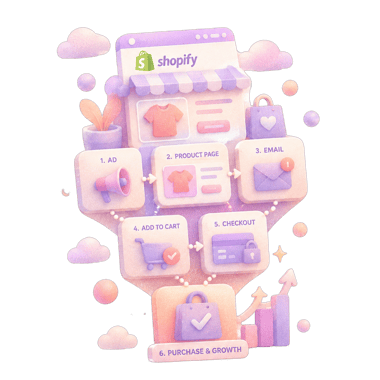
- The Shopify sales funnel has four stages: discovery, consideration, conversion, retention. Each has different traffic, different content, and different metrics.
- Most stores over-invest in conversion (the bottom of the funnel) and under-invest in retention (after the first order). The math compounds the other way.
- Email + SMS is the funnel’s connective tissue. Without it, every customer is acquired fresh; with it, retention compounds.
- The funnel only works if the offer at each stage matches the intent. Don’t show a 10%-off popup to a returning loyal customer.
This piece walks through a working DTC sales funnel on Shopify - what each stage does, what content to build, what tools to use, and what to measure.
Why you can trust us
Four years inside Shopify. We build Fudge, used to ship the storefront-side of every funnel stage - from cold-traffic LPs through PDP optimisation to subscription pages.
The four stages
Stage 1: Discovery
The visitor doesn’t know you yet. They’re discovering you via paid social, organic search, content, or referral.
Goal: capture attention and the email.
Content: ad creative, content marketing, organic-search-optimised category pages, founder/brand story content.
Storefront surface: ad-matched landing pages, blog content, category hubs.
Metric: email capture rate (target: 2-5% of sessions), session-to-engagement ratio.
Stage 2: Consideration
The visitor knows you exist. They’re evaluating whether to buy.
Goal: answer their qualification questions and route them to the right product.
Content: PDPs with strong clarity, comparison content, review depth, quizzes for overlapping-SKU categories, email nurture flow.
Storefront surface: PDP, quiz, comparison pages, FAQ, “how it works” content.
Metric: add-to-cart rate (target: 5-10% of PDP sessions), quiz completion rate if applicable.
Stage 3: Conversion
The visitor has added to cart. They need to complete the purchase.
Goal: remove friction at cart, checkout, and payment.
Content: cart drawer with trust signals, abandoned-cart email, retargeting ads.
Storefront surface: cart drawer, checkout (Plus: Checkout Extensibility), thank-you page.
Metric: cart-to-purchase rate (target: 40-60%), checkout abandonment rate.
Stage 4: Retention
The customer has bought. The funnel work isn’t done - first-order LTV is a fraction of long-term LTV.
Goal: convert one-time buyers to repeat buyers.
Content: post-purchase upsell, welcome series, replenishment reminders, subscription, loyalty program.
Storefront surface: thank-you page, account portal, subscription management.
Metric: repeat purchase rate (target: 25-40% within 90 days for consumables, lower for considered purchases), LTV / CAC ratio.
What to build at each stage
For discovery
- Ad-matched landing pages - see Shopify landing page examples for patterns.
- Email-capture popup - tuned correctly, see Shopify newsletter popup guide.
- Blog and content for organic search - editorial content tied to product.
- Founder / brand story page - especially important for premium categories.
For consideration
- High-converting PDPs - see anatomy of a high-converting product page.
- Quiz if your category fits (overlapping SKUs, personal context).
- Comparison content for stores fighting an entrenched competitor.
- Email nurture flow - educational, not promotional, for the first 5-7 days post-signup.
- Reviews depth - filterable by relevant attributes.
For conversion
- Cart drawer with upsells - not a full-page cart redirect.
- Trust signals at the buy box and cart - returns, shipping, payment options.
- Abandoned cart email - within 1 hour, 24 hours, 72 hours.
- Express checkout buttons - Shop Pay, Apple Pay, Google Pay.
- Pre-disclosed shipping cost on the PDP.
For retention
- Post-purchase thank-you page with upsell, content, brand story.
- Welcome series - 3-5 emails post-first-order.
- Replenishment / reorder reminder for consumables.
- Subscription option at the PDP if the product fits.
- Loyalty program for stores with meaningful repeat frequency.
The tools
For each stage, an opinionated stack:
Discovery:
- Meta Ads, Google Ads, TikTok Ads for paid
- Shopify Email or Klaviyo for email capture
- Fudge for landing-page builds
Consideration:
- Reviews app (see best Shopify review apps)
- Quiz tool (Octane AI, Shop Quiz, or built natively with Fudge)
- Klaviyo for email nurture
Conversion:
- Native Shopify cart drawer or upgraded with Rebuy
- Klaviyo for cart-abandon flows
- Checkout extensibility for Plus stores
Retention:
- Klaviyo for lifecycle email
- Shopify Subscriptions or Recharge for subscriptions
- LoyaltyLion or Smile.io for loyalty programs
- ReConvert or AfterSell for post-purchase upsells
For the wider CRO context see Shopify CRO guide and best Shopify apps for CRO.
The metrics to watch by stage
Discovery
- Email capture rate
- Cost per email
- Click-through rate on ad creative
- Cost per session
Consideration
- Add-to-cart rate
- Quiz completion rate
- PDP scroll depth (real-user data)
- Time on PDP
Conversion
- Cart-to-checkout rate
- Checkout-to-purchase rate
- Cart abandonment rate
- Average order value
Retention
- 30-day repeat purchase rate
- 90-day repeat purchase rate
- 12-month LTV
- Subscription opt-in rate (if offered)
Don’t try to optimise everything at once. Identify the stage where you trail benchmark most, work there.
What separates working funnels from failed ones
Three patterns.
1. Offer matches intent at each stage
The cold visitor gets a discovery offer (“10% off your first order”). The cart visitor gets a conversion offer (“free shipping if you check out now”). The repeat customer doesn’t get either - they get an exclusive new-product preview. Misaligned offers waste margin.
2. The data is connected
Klaviyo (or your ESP) sees the customer’s purchase history, browsing behaviour, quiz answers, and lifecycle stage. Without connected data, each touchpoint is generic.
3. The funnel pays the back-of-funnel
Most stores under-invest in retention because it’s not as visible as ad spend. The math: a 10% improvement in 12-month LTV usually returns more revenue than a 20% improvement in cold-traffic CR. Build for retention.
FAQ
For an established store: retention. For a new store: discovery and consideration (because retention math requires customers in the first place). Most stores over-invest in conversion and under-invest in retention.
5-10 touches over 14-21 days for cold leads. Don't go silent after touch 3; the highest-converting emails are often touch 5-7. For warm signup leads (popup → purchase intent), shorter flows of 3-5 touches work.
Yes, sparingly. SMS open rates are 90%+ but the tolerance for noise is low. Best use cases: cart-abandon (high-intent moment), shipping notifications, BFCM offer notifications. Don't use SMS for routine marketing.
Shopify Analytics + GA4 + your ESP's analytics + an attribution tool (Northbeam, Triple Whale, Rockerbox) for paid attribution. Most stores under $1M can get by without a paid attribution tool.
For consumables: 25-40% repeat within 90 days. For considered purchases: 5-15% within 12 months. For one-time-purchase categories (mattresses, furniture): much lower, focus on cross-sell within the visit instead.