
Key takeaways
- The three are all built on the same Online Store 2.0 architecture. The differences are aesthetic and out-of-box section variety, not technical capability.
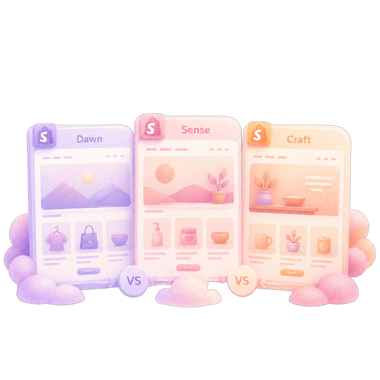
- Dawn is the most-deployed and the fastest baseline; Sense leans warm and consumer-soft; Craft leans premium and artisanal.
- For most stores, the right pick is the one whose default aesthetic is closest to your brand - you’ll customise the rest anyway.
- The choice rarely matters as much as how you customise. A heavily customised Dawn often looks nothing like the demo store.
This piece compares the three most-deployed free Shopify themes: Dawn, Sense, and Craft. Same architecture underneath; different defaults.
Why you can trust us
15+ years of dev experience, four years inside Shopify. We build Fudge, which means we work inside live Shopify themes daily. The patterns below come from real customer stores running each.
The shared architecture
All three are Online Store 2.0:
- Section-based layouts on every page
- JSON templates
- App blocks supported
- Metafield-driven content
- Modern accessibility defaults
So the technical capability is functionally the same. What differs is what’s pre-built.
Accessibility defaults are just defaults, though. Whichever theme you pick, your content and apps still decide the outcome, so audit the live store for Shopify ADA and WCAG compliance before launch.
For the wider free-theme view see best free Shopify themes.
Dawn
The reference theme. Most-installed Shopify theme by a substantial margin.
Aesthetic: clean, modern, neutral. The default that doesn’t get in the way of customisation.
Out-of-box sections: comprehensive baseline - hero, featured collection, image with text, multi-column, rich text, video, collection list, slideshow, contact form, blog posts.
Speed: typically the fastest of the free themes on a clean install.
Best for:
- New stores wanting a neutral starting point
- Stores that will customise heavily anyway
- Stores using a page builder or AI editor for storefront-specific work
Trade-off: the default aesthetic is recognisable. Without customisation, your Dawn store looks like every other Dawn store.
Sense
The warm consumer theme. Beauty, wellness, lifestyle.
Aesthetic: softer, warmer, friendlier. Often pastel-leaning out of the box.
Out-of-box sections: strong hero options, image-driven sections, lifestyle content blocks.
Speed: comparable to Dawn within a few Lighthouse points.
Best for:
- Beauty and skincare DTC
- Wellness brands
- Consumer-soft lifestyle (candles, home fragrance, soft goods)
- Stores that want a warmer default without heavy customisation
Trade-off: the default aesthetic is harder to push toward an edgier or more technical brand identity. Customisable, but you’re working against the grain.
Craft
The premium artisanal theme. Curated, considered, hand-made.
Aesthetic: typography-led, often serif-heavy, premium-leaning. Heavy use of negative space.
Out-of-box sections: strong editorial-style sections, multi-column layouts, slow-scroll hero patterns.
Speed: comparable to Dawn within a few Lighthouse points.
Best for:
- Premium DTC (high-AOV)
- Artisan and craft brands
- Jewellery, leather goods, premium home goods
- Heritage and family-owned brands
Trade-off: the aesthetic skews toward considered/quiet. Stores wanting energy and impulse will fight the defaults.
How to choose
Three quick questions.
1. Which default aesthetic is closest to your brand?
If your brand is warm/soft/feminine: Sense. If your brand is premium/considered/heritage: Craft. If your brand is bold/contemporary/category-agnostic, or you’ll customise heavily: Dawn.
2. How much will you customise?
If you’ll heavily customise (rebuilding sections, restyling, replacing hero modules), the starting theme matters less. Pick whichever aesthetic is closest and customise from there.
If you’ll run mostly out-of-box, the aesthetic match matters more. Pick the theme whose defaults you’d ship.
3. Do you care about speed differences?
For Lighthouse difference within 10 points of each other on a clean install, you won’t notice the difference vs the impact of your apps. Pick on aesthetic and section fit.
What none of these themes do well
All three are general-purpose. None has deep category-specific features built in:
- Quizzes - none ships with native quiz functionality. Use a product recommendation quiz build or app.
- Bundles - basic bundle support exists at the platform level; theme-level bundle pages aren’t built into any of these.
- Subscriptions - need a subscription app (Recharge, Loop, Shopify Subscriptions).
- Wholesale - need Shopify Plus B2B or an app.
For these, you’re building on top of the theme. See best Shopify page builders.
Other free Shopify themes worth knowing
If none of these three fits:
- Studio - editorial / high-design (fashion, art)
- Refresh - youthful, athletic, bold colour
- Origin - heritage and story-forward
- Crave - food and drink-specific
- Colorblock - graphic / contemporary
- Publisher - editorial / magazine
See best free Shopify themes for the wider view.
FAQ
Marginally - typically a few Lighthouse points faster on a clean install. The difference is smaller than the impact of your apps and images. Not a decision factor for most stores.
Section configurations don't transfer cleanly between themes. Plan a switch as a rebuild project. Use an unpublished theme copy to build the new version before going live.
Mostly no. Paid themes have larger section libraries and stronger out-of-box aesthetic, but the underlying technical capability is comparable. Pay if a paid theme solves a specific structural problem; don't pay for marginal aesthetic differences you'd customise anyway.
All three are OS 2.0 themes and support sections-on-every-page, JSON templates, app blocks, and metafields. None has an advantage over the others on this dimension.
No - SEO output is functionally identical across the three. Schema, sitemap, meta tags, accessibility, structured data - all the same. Differences in real-world SEO come from content and links, not theme choice.